I gave a talk at the Nrth Conference Elevate Festival today in downtown Toronto. I am sharing the talk and the notes in their entirety here:

To glean a new perspective, we need simply to look critically at our existing standpoint.
How well do we know our viewpoint? How did we learn what is important, what to notice, what to consider, what to prefer, what to aspire to? Those aren’t small questions. They often get at foundational principles, and those are often given to us early in our lives. And I say given to us, because many of us were taught early what mattered and what didn’t – there was no opt-in. There were adults and systems that subtly, surreptitiously, or explicitly told us what mattered. It’s part of forming our own ethic: we have to carve our way through complexities, exceptions to the rule, counterexamples, and more that push the edges of what we believe and how we understand our own limits.

As AI embeds itself into our systems, our homes, and our own bodies, we are confronted by the question of what it means to be human. Now more than ever we’re confronted by these philosophical, ethical, foundational questions like how human are you? Ai is the branding, but the technology is in us, is part of us. Where do we draw the line? It has called cognition into question: what it is and who has it and what rights should be afforded them as a result. As AI systems push us these edges we are unprepared and so far unable to regulate this area meaningfully. We are not ensuring that AI does not cause harm, and is limited in what it can do. And harms abound…
https://www.cbc.ca/news/canada/ottawa/ottawa-company-develops-robotic-arm-to-lend-a-hand-to-people-with-disabilities-9.7274476
https://www.yalemedicine.org/conditions/cardiac-pacemaker
https://fr.wikipedia.org/wiki/Fandom_furry#/media/Fichier:ChipFox_Fox_Fursuit_2015.jpg


Data centres changing temperatures in cities, chatbots that advocate self-harm, past actions used as the tea leaves for future actions, disembodied decisions, and more…
Where do we reassert ourselves and say this is the limit? Where are our limits for harm?
https://www.brighthope.org/blog/what-causes-poverty/
https://www.makepovertyhistory.ca/poverty/
https://www.downtoearth.org.in/governance/life-in-debt
https://www.elevatecounseling.com/blog/what-does-being-transgender-really-mean/

If we return to what it means to be an embodied human, and then we think laterally, we can reconsider the everyday things around us, we can adapt our world to work better for us. We harness our own needs and preferences as motivation and impetus for design innovation… That is when we choose what matters to us—what to fix, adapt, focus on… We innovate for mismatches and solve problems that everyone benefits from: text message, electric toothbrushes, curbcuts… those are all innovations that came from focusing on the needs of a few that everyone benefits from.
But our vision is interrupted…
https://mir-s3-cdn-cf.behance.net/project_modules/max_1200/c197fe12573867.5626b37341323.jpg
https://www.cntraveller.com/article/ostrich-pillow-travel-gadgets
https://mir-s3-cdn-cf.behance.net/project_modules/max_1200/c197fe12573867.5626b37341323.jpg
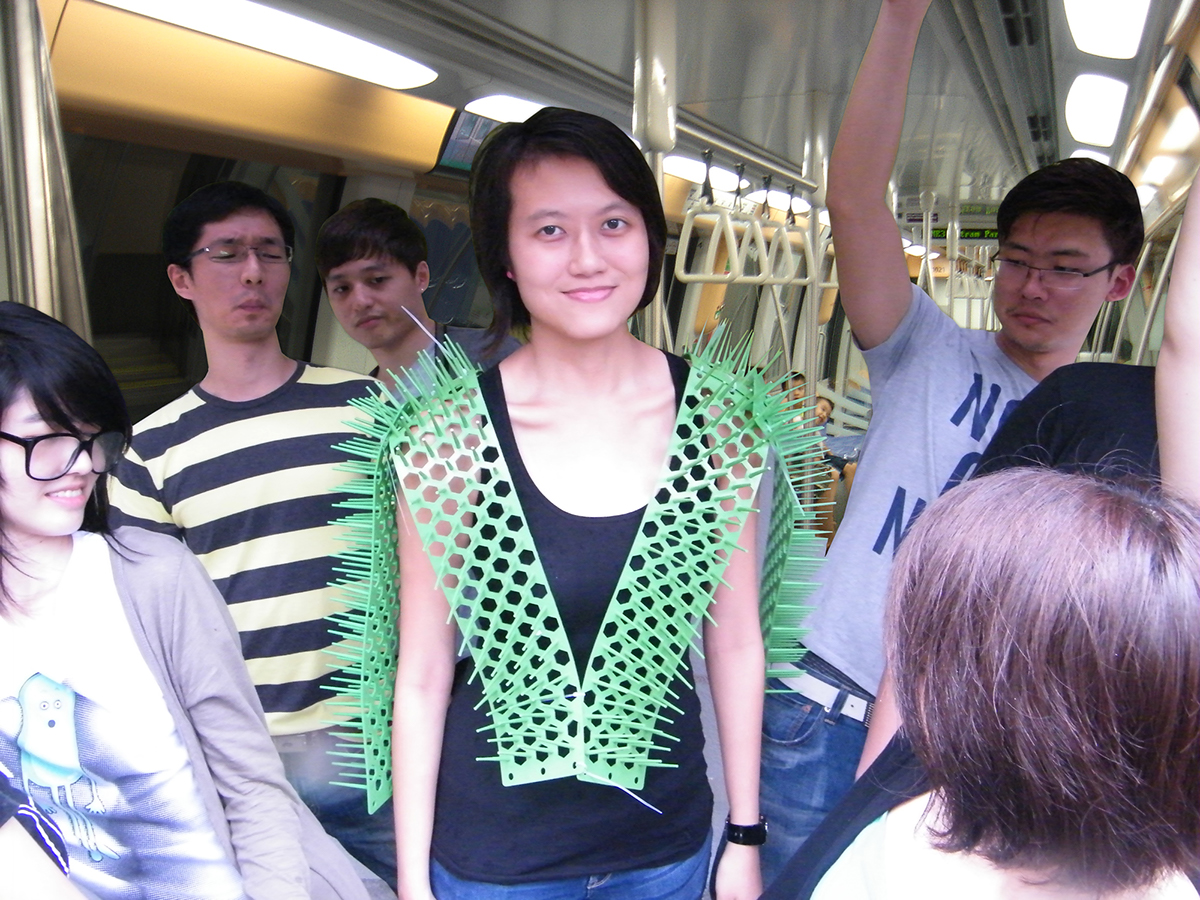
Spike Away – How to Protect Your Personal Space On The Subway
An idea that was conceived as an undergraduate during a short 1.5 day “Chindogu” workshop at the National University of Singapore, held by German furniture designer Werner Aisslinger. “Chindogu” is the Japanese art of designing ingenious gadgets to solve one mundane, everyday problem.
A quick brainstorming leads to a everyday situation. Trains are usually crowded during peak hours. Everybody will push each other to try and get onto the train. How can I protect my personal space?
The idea was then conceived. “What if I wear a vest that is full of spikes?”
Attendees are given half a day to source for materials and hack together a prototype that represent the idea. The vest is made of strips of spiky, flexible plastic material found in the gardening section of a handy store. The strips are looped together with cable ties. Fittingly, it was normally used to keep birds and cats away from plants.
https://www.cnet.com/news/spike-away-vest-keeps-people-out-of-your-personal-space

into that moment technology comes in, shifts our focus taking primacy (we look at the screen, the phone, the text that just came in), bends our focus toward an algorithmic way to see, and gives us strong messages about what matters: likes, clicks, money.
This isn’t a call to eradicate techno-solutions from our lives – it is an alarm to make decisions about when and where it should be and how it should be in those spaces. Should it interrupt? Should it intrude? Or should it empower and enable? And who will decide and who will regulate?
https://steamcommunity.com/sharedfiles/filedetails/?id=428636263

What do we come to when noise drowns out thought, innovation becomes synonymous with automation, people struggle with loneliness and isolation, and machines take centre stage. What does fairness look like? What is success? How can we (humans) thrive within this dissonance?
https://newatlas.com/bicycles/top-10-bicycle-innovations-2025
https://www.heidenhain.us/resources-and-news/machine-tool-automation-what-it-is-and-why-its-needed/

What is wild? Do you ever feel like scrapping it all and starting over? Going offline? Off-grid? Rural? More organic?
https://www.instagram.com/p/DXyqhbCDJjd/?img_index=4

In he gave on October 1, 2015, at the Strata+Hadoop World conference in New York City. https://idlewords.com/talks/haunted_by_data.htm
Maceij Ceglowski said the following:
You can’t just set up an elaborate surveillance infrastructure and then decide to ignore it.
These data pipelines take on an institutional life of their own, and it doesn’t help that people speak of the “data driven organization” with the same religious fervor as a “Christ-centered life”.
The data mindset is good for some questions, but completely inadequate for others. But try arguing that with someone who insists on seeing the numbers.
The promise is that enough data will give you insight. Retain data indefinitely, maybe waterboard it a little, and it will spill all its secrets.
There’s a little bit of a con going on here. On the data side, they tell you to collect all the data you can, because they have magic algorithms to help you make sense of it.
On the algorithms side, where I live, they tell us not to worry too much about our models, because they have magical data. We can train on it without caring how the process works.
The data collectors put their faith in the algorithms, and the programmers put their faith in the data.
At no point in this process is there any understanding, or wisdom. There’s not even domain knowledge. Data science is the universal answer, no matter the question.
Understanding, wisdom, our why…
Photo by Pierre-Olivier Carles

You see, speculating about the future often depends on what happened in the past (simple patterns) to predict what will come (again). Language models, patterns of behaviour, sunrises, actuaries, awarded grants, performance all take this approach… It might actually be hard to find something that ISN’T determined by the past or at least threatened to – reminds me of the warnings about YOUR PERMANENT RECORD following you around forever… Anyone still crushed under the blemish on their permanent record from their k-12 years?
But that isn’t very sophisticated is it? Patterns is all we get? And we know data isn’t neutral. So, we repeat and perpetuate our own bias and existing inequity? That’s the best we get?
Well, let’s just establish that seeing everything as patterns isn’t too sophisticated and it feels downright deterministic. Maybe it’s efficiency, maybe it’s probability, maybe it’s resignation or laziness. We want certainty but most of life is complex and does not lend itself to certainty.
https://fallout.fandom.com/wiki/Yes_Man

https://ichabilal.wordpress.com/wp-content/uploads/2012/02/choices.jpg?w=448&h=269
We are at an inflection point.
What will we do with the immeasurables? With the false dichotomous ruts of thinking and doing? With the machines? With the people? With the value(s) of our planet and the people on it?

Let’s talk about those things that only we, humans can do…
The relational
The immeasureable
The subtle
The nuanced
The in-between
We don’t have to be robots and arguably we never should have fashioned ourselves thusly.
Leave a Reply